Wednesday, November 30, 2011

Cameras: Advantages and Disadvantages

DSLR advantages

1) isolate your sibject and force the viewer to look at what you intend them to look at. Also, the sensor on these cameras is amazing and allows the filmmaker to capture amazing colors as well as images in low light which can be amazing for documentary!

DSLR disadvantages:

1. Sometimes I want to see the background! there are other tools in directing the eye besides crushing the d.o.f
In this example this looks like a portrait of a place, but you can hardly tell where any of the speakers are because the background is so out of focus. In my opinion, it takes away from the actual place they are trying to highlight.

The Ex3, in my opinion would be a better documentary camera.
yes, it doesnt have and ISO but it is easier to hold and you are able to interchange lenses much like the dslr. The only problem with the EX3 is if you wanted to set it up to it's full capability ( matte box and red rock adapter)  you would need more than one person to operate it and a LOT of time to set it up.

Camera Movement

Sometimes alot of movement can be TOO MUCH movement. What I've learned over all about movement of the camera is that subtle is best! When you watch movies, without a trained eye, you notice that something weird happened with the shot your looking at, but it wasn't anything you could describe. All you know is it fit with the story. So subtle quick movement in my opinion can be the best movement. My favorite movement is the character push-in. After watching movies for so long I had never noticed that in almost every movie when a person finds something out new, or is lonely there is a character push in or push out to add dramatic effect.


I also like wired movements to add to the awkwardness of a movie. For instance in Spike Lee's "Inside Man"

Speed up to 0:57. Cool way to add tension and focus of the eye without crushing the d.o.f.

Scene Assignment Relflections

I had a great time doing the scene assignment. Overall, it was a great lesson in patience. Sitting on a set for 6 to 12 hours at one time is no small feat. Even if you are just gripping or gaffing paying attention to detail is VERY important, and paying attention the entire time is the most important. As director, again I learned that it is really hard to articulate what you want your movie to look like. Also I learned that there can never be enough pre production. Even if you don't want to shoot narrative films, having a definitive idea about what you want to achieve visually is crucial to succeeding as a film maker. I enjoyed working with my group. I gaffed and gripped four project and dp'd one and directed one. So my plate was full! But I enjoyed every moment of it. The scene assignment was great hands on experience, we got to touch and understand the equipment we learned about in class and that is priceless.

I still don't want to direct narrative films, but this assignment taught me that I can manipulate light for my documentaries as well. Viewers like to see visually interesting dynamics playing out on screen regardless of the genre so learning these lighting skills was definitely an advantage. Even manipulation of natural light can add the little bit of creativity you are looking for to make a subject look more dynamic. In many ways lighting compliments your story by adding depth and mood.

Tuesday, November 29, 2011

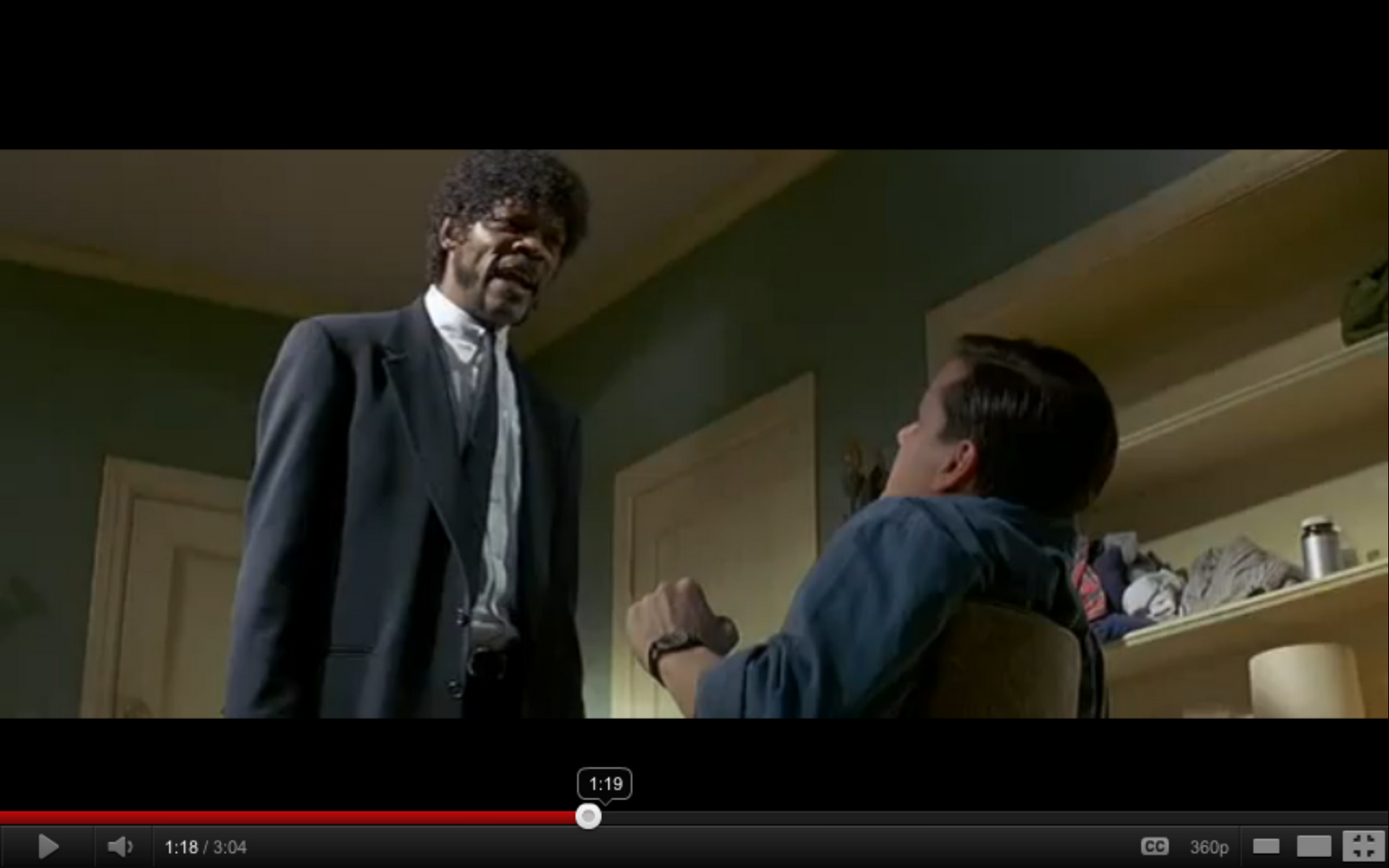
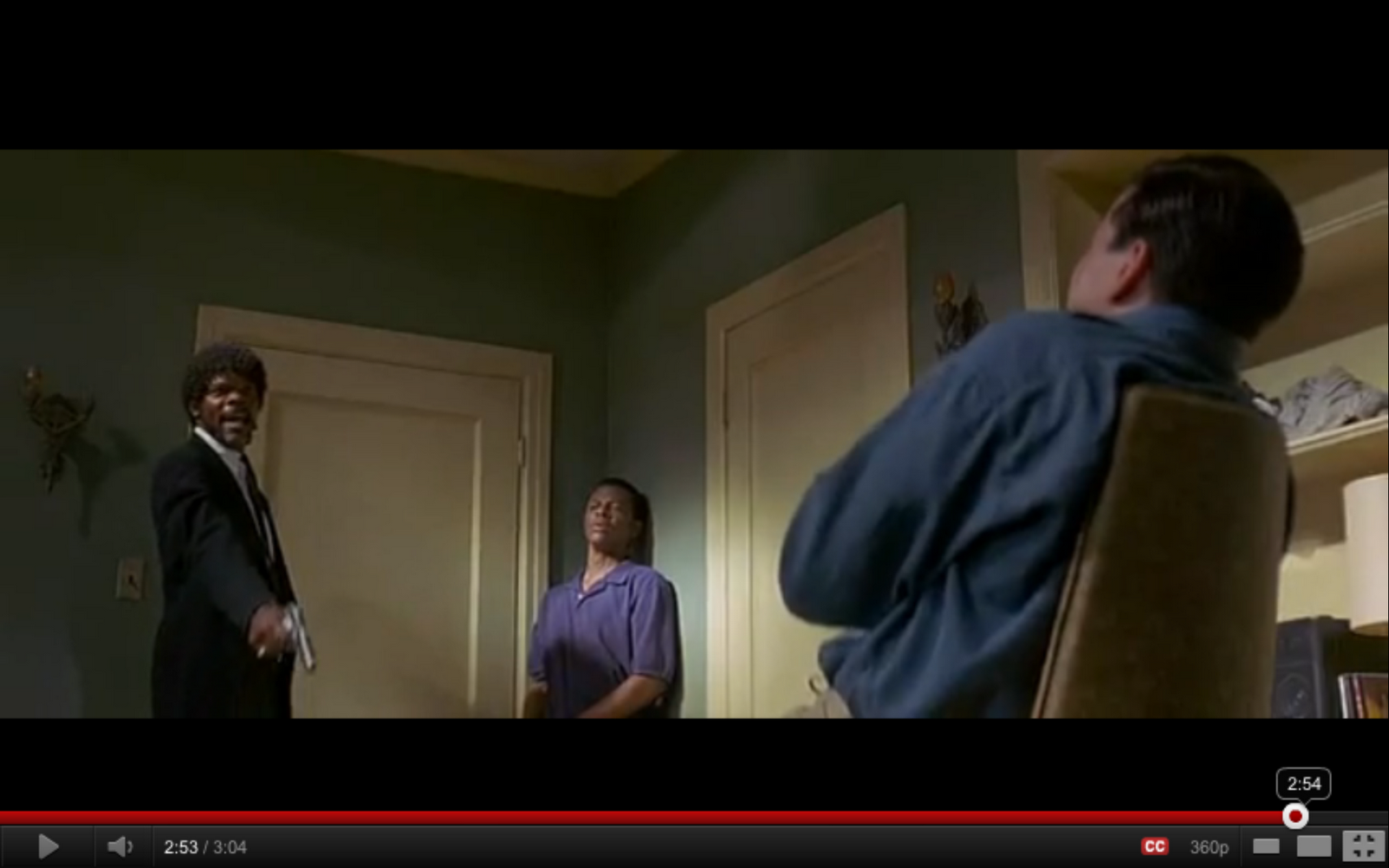
Shot by Shot Analysis: Pulp Fiction

I love this scene because the tension is built so creatively. We don't even know the background to the story (who these people are where they come from) but as the story progesses it's like we've been watching the movie for almost am hour.

we see Vincent, a gangster, is looking for something very important. In fact what he is looking for has rimmed his face in gold letting the viewer know it's something valuable.

As it cuts to his partner we see Samuel L Jackson is the only person in the room standing upright. He is in the position of power. Non verbal plays a pretty big role here, because at this present moment, there are no guns.


Vincent walks around the counter.
The Camera Follows him to add visual interest and style.
Again we see Jackson the only person standing. But the guy in the blue shirt seems to think he can talk his way out of his situation and begins to feel powerful. I also like the smoke in the upper left to remind us that Vincent is still here even though he's not in the frame.

As the guy in the blue shirt stands he challenges Jackson's power. But Jackson is not phased, Jackson simply motions his had for the young man to si back down. (without a gun) 

The guy in the blue shirt sits. The framing of this wide shot gives the audience a calm feeling.
Nothing too intense should happen in a ws right? Wrong! All of a sudden the calmness is disrupted and the tension starts to build as Jackson shoots the man on the couch.
As the scene grows more intense we start to see more medium shots and the expressions of each person's face.
The medium shots add to the tension of the scene. But then we strt to see close ups which add even more intensity.
There is brief conversation over the next few frames, but the fact that Jackson is towering over the man in blue is scary and suspenseful.


When the tension is reaching a peak we move back out o a wide shot to remind us of where we are.
Also, the framing is intense, we know that Jackson is the biggest in the frame so he is definitely the most powerful.
Now we see Vincent's pov and Vincent looks oddly calm adding to the fact that they do this quite often. Also this shot gives some visually relief from the back and forth cu shots
The back to the intensity. The lighting is dark but even, I like that there are no hard shadows...it adds to the reality of the situation.
Here we don't even need to see Jackson, the gun is enough to frighten the audience and build suspense. It's also a little funny that Vincent is in the background calmer than ever.
Here in these next few frames the intensity builds up again from the MCU to a CU


Now we see more tension. The shot seems as if it were canted but it's not. Here we know again who the dominant power is.

The guy in blue gets shot. It is important that we see Vincent is not phased. It's a great element of story telling that all Vincent does is put out his cigarette, while the guy in blue is panicked.


Again, the tension build with a MS
Jackson is standing in the middle of the floor the only person upright in the frame. No one is taller than him (not even the guy in the background)
Here we know that this is the climax because we atrt to see ECUs


The intensity has built
Now we see Jackson's target...more tension building

And finally we watch Jackson pull the trigger. I like that we stay of Jackson instead of the guy in blue, because the we understand who's story it is. Jackson is doing the action and is the person the viewer is supposed to be watching and connecting with

Thursday, September 22, 2011

PRINT


went back and added some nat. sound too! I've learned so much when it comes to using the sony hdv. For this assignment Luke and I played around with Polorizer Filters. It was fun to take the camera apart, place a new filter on the camera and see the difference/enhancement in our colors. Also, I learned I really like work-shopping our work. Having people critic you is a great opportunity to get feed back. As far as the project, I learned it's hard not to touch the camera. It's my vision, but I can't physically help make that vision happen. That's hard. Not being able to touch the camera forced me to vocalize what I wanted. It helped me remember terms like high angle, crush the depth of field, open your iris, lower your shutter ect...Overall it was a really fun experience. The book arts program is absolutely fantastic.

Wednesday, September 21, 2011

Reflections

Its an interesting question, What have I leaned so far? I have learned a lot! I have learned the importance of color temperatures when lighting a scene. Also, the crucial importance of white balancing your camera. Also, organization is crucial when planning to go on a shoot, even if you think it's going to be a simple point and shoot and wrap set. I've learned about filters and their importance, I have learned the basics of shutter speed, aperture, color temps, depth of fields, and about the aptitude of several different cameras like the HDV and JVC. I've also learned cinematography is an important concept for ever gorilla documentarians to understand, because style, tone, and look are all important when you are telling a story visually.

The most challenging thing i have had to learn is lighting and trying to break away from the writer side of myself.  I come from a writers background. I love non fiction writing and that is part of the reason I decided I wanted to be a documentary film maker. However, translating non fiction writing into a visual piece of art work has been difficult and frustrating. For instance in a  documentary you can't just show talking heads you have to have visual variety to tell your story because that's what makes the story more appealing and ultimately that's what you're audience expects. Now, lighting is something I have never done before except for that one time in Schwartz's class :). So This is definitely foreign territory. However, I accept the challenge. Trying to articulate a vision visually is one of the most interesting skills I have ever had to try and accomplish.

The Rewarding thing about videography  is succeeding once I have failed. I have learned that I WILL FAIL! but that's okay. I think the most rewarding thing for me is learning patience and that I won't be the best at everything right out of the gate.Film-making takes time, preparation, and knowledge. But the most gratifying thing is knowing that I am learning and that if I fail, I learn from the mistakes I make. Lessons leaned: always white balance, Always check the equipment to see if it works, and always stay organized. I am happy to have the time to fail in a comfortable place where we are all learning and we will all take our learned experiences of this class and turn them into something great.

Tuesday, September 20, 2011

Ligthing Styles

Natural Light Manipulation

As a documentarian, I would imagine myself in situations where I really wouldn't have time to take hours upon hours to set up lights. Unless it's a talking head interview. So how do I get visually interesting shots without any c stands, nets flags or lighting equipment? Hopefully I will be observant enough, much like the photographer who took the picture above, to manipulate natural light in order to compliment the beauty of the story.

When viewing the manipulation of natural light and shadows, it interest me because of how simple and complex light can be. I can appreciate the manipulation of natural light because it seems that you are working with the elements that surround you. Observing natural light is amazing to me as well because it's everywhere! Light exist in neat shapes; surrounding objects and creating soft and hard lines or shadows.

Hard Light

Hard Lighting is also a favorite of mine. I think Xavier said that shadows give character and I completely agree.Also, the depth and texture that shadows give create some of the most beautiful images that I have seen. Adding texture to a photo like the one above allows the viewer/observer to relate in an more intimate way.